home > menu > about > living arts in jungle mohol
LIVING ARTS IN JUNGLE MOHOL
Theatre Proposal to Tribal Villagers
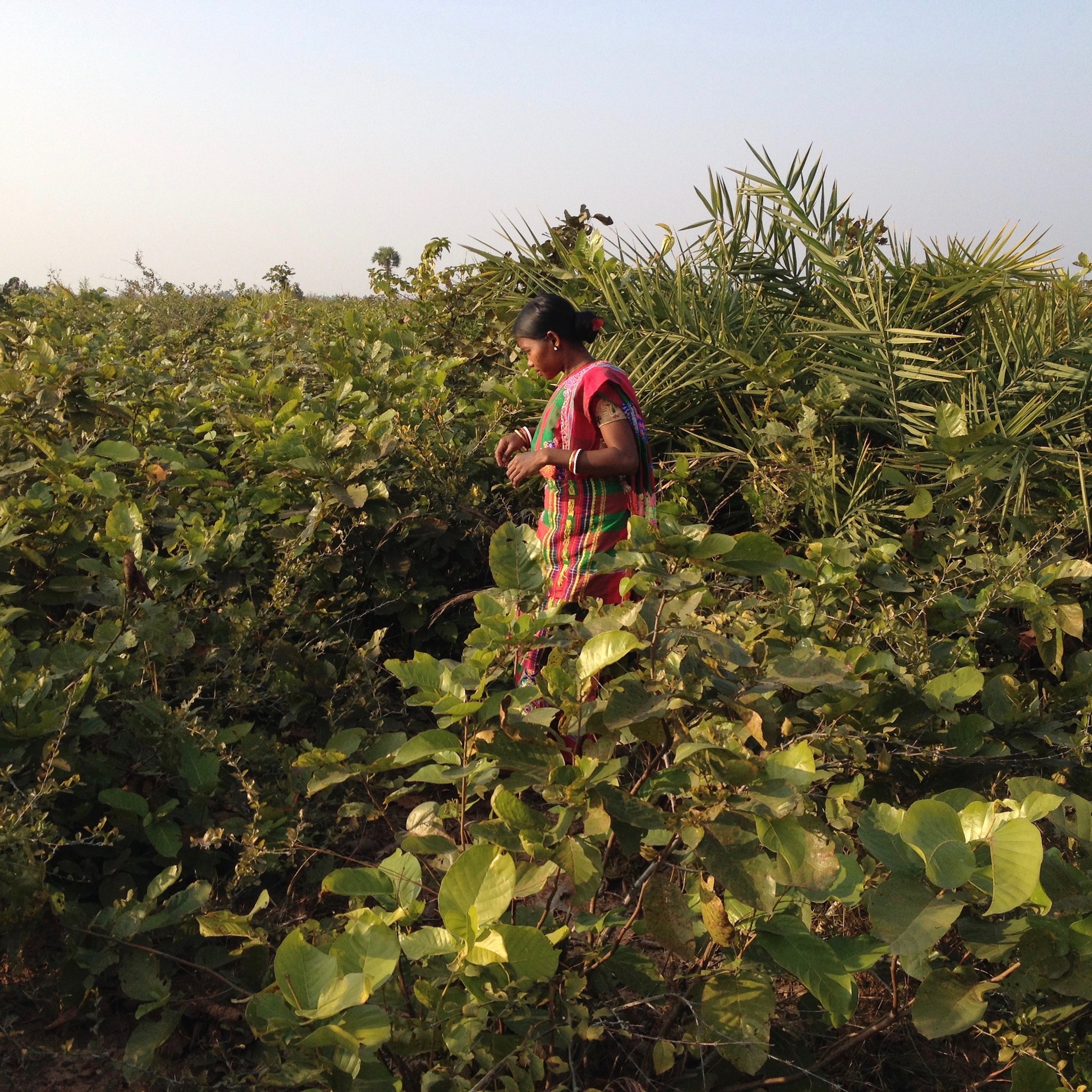
Imagine a street, or better still –this one being less than four metres wide– imagine a narrow road made of hard-packed reddish soil stretched over about a kilometre, and lined on both sides with one- or two-storey mud houses shaded by majestic trees. Often, chickens, buffaloes, calves, a few goats and some blackish-muddy pigs roam along it. Early morning, as well as late afternoon, scantily clad children, especially boys, play marbles on it, bows and arrows or –with old inner tubes recovered from their parents’ cycles– rolling hoops. All day long, girls in brightly coloured tunics and women in garish saris walk up that road, carrying newborns on their hips, or the water they have just drawn from the well. Late at night, between October and March, elephants cross it in search of paddies, delicacies and fermented drinks.
This street, which I discovered one morning in August 2008, is Borotalpada, a remote tribal village located in an area nicknamed the Jungle Mohol, within the southwest part of the Indian state of West Bengal, a few kilometres after crossing the Subornorekha River and a few other kilometres before reaching the Orissa border. It has half a thousand denizens.
Seven o’clock has just passed. With Sukla, my wife, we get out of the ambulance an organisation in Calcutta has assigned to us for the trip.
There are around thirty people waiting, of all ages. I have come to propose that we stage a ‘theatre’ performance together. I add that the word ‘theatre’ surely does not mean the same to everyone, and therefore it is something from which we can all learn by doing what it actually covers and implies. I also add that this ‘theatre’ piece will be offered(I insist on this verb) to Borotalpada inhabitants and then to other audiences in Calcutta.
What follows is a lively discussion in Santhali of which I understand nothing, nor does Sukla who has until then translated into Bengali. Santhali is an Austro-Asiatic language distinct from the Sanskritic and Dravidian languages, majoritarian in India. After a few minutes, the palaver stops, and we are told (in Bengali) that the proposal is accepted. We must now agree on the calendar (not to interfere with agricultural labour, a young lady says), the schedules (three hours daily for three consecutive weeks, I suggest) and the logistics of rehearsals. The most debated point concerns the opportunity or not of a tea break during which biscuits will be distributed. I am assigned the task of bringing tea leaves, sugar, snacks and cups; the duty of finding a big pot, collecting wood and boiling the water is given to four village women.
That done and without any time for me to think about it, a girl takes hold of my right hand, another of my left hand, the men grab their drums, and we all begin to dance.
Brief on Santhal Dances
Santhal dances fascinate me. It seems that nothing changes in them and yet my eyes never tire of following the dancers’ uninterrupted circular path. My gaze thus carried, I feel a sort of quiet excitement. Is it the rhythm? Is it the group’s togetherness? Is it the repetition of the same steps with slight accelerations and progressive modifications that makes the same ending turn into something else?
The movements take up –while stylising them– ancestral gestures performed during the harvest in the fields or when searching the jungle for medicinal herbs, leaves or roots. However, they don’t aim at representing these actions. Their function is sometimes to greet guests who visit the village, at other times to maintain social ties among the villagers themselves, and on other occasions to weave new relationships between members of distant villages. But that’s not what captures my attention either. I am carried away, that’s all. Moved and therefore set in motion, what passes through me is so rich that I do not feel like freezing it by attaching a predetermined signification to it. Neither subjugated nor paralysed, my senses and my thoughts go further, deeper. If I question that depth later, the interrogations relate to the benevolent abyss that has unexpectedly opened up.
Non-Figurative Figurines
There are animal figurines made of raw clay that the Santhals place under trees at the edge of the village according to a ritualised procedure which lasts at least half a day and precedes sowing. These clay figurines do not strictly represent specific animals –in fact, one would have trouble identifying them exactly. A man smears them with the blood of little chickens that other men have just slaughtered. This is Aserie Bonga. In Santhali, aseri means sowing and bonga, religious ceremony.
On three other occasions, little chickens are thus slaughtered and their blood smeared on clay figurines: for Magh (month) Sim (talks) Bonga which is followed by discussions; for Baha (flower) Bonga during which blooming flowers are offered; and for Mah Moré (after the harvests) when fresh rice grains are thrown on the ground.
Although neither women nor foreigners are usually allowed to attend the Aserie Bonga ceremony, Sukla was there with me.
Gastronomic Care
Delko Hansda, whose husband and daughter participate in the rehearsals (he as a musician, she as an actress-dancer) often keeps up the energy of the stage director that I am, discreetly providing me –during tea breaks and even sometimes in the middle of a work session– with grilled leaves, beef, pork or fish curry, and rice beer.
Rice Beer & Methanol Extraction
A few words about rice beer. It can be enjoyed in two forms: a less strong one with a thick white consistency and a light ochre liquid one with a high alcohol level. In Santhali, the first is called hâri and the second djar hâri or tâng hâri – hâri refers to the container in which cooked rice mixed with yeast has fermented for five days, djar to the earthenware strainer over which it is pressed and tâng to the act of pouring the liquid in order to offer it. In Bengali, hâri has become hâria and tâng hari is rossi. Ros, from the Sanskrit rosa, can refer to the juice of a fruit bursting in the mouth or to water escaping from an overfilled jug, the flow of milk or sap, and by extension, to the essence of a perfume, its flavour, and from there, to aesthetic pleasure.
Whatever language one uses to name them, one should be careful to not be in a hurry: the rice, which has first been lightly toasted, must cool before being boiled. Once cooked, it must cool again before yeast is added.
And to taste it, in any of its forms, one should avoid both strong heat and extreme cold: rossi (or tâng hâri) and hâria (or hâri) can be best appreciated in autumn and spring. The place of production must also be taken into consideration. In northern Bengal villages, rice beer, although served hot as in Nepal and Tibet, has neither the roundness nor the strength that characterise that of Borotalpada where each woman who prepares it has, in addition to her know-how, her own style and habits.
Beer making is therefore women’s business. There is another beverage produced in families without distinction of gender. It is the distillate of a macerated flower called mohua. The operation takes place once or twice a week. And invariably, the fire under the locally made still being fuelled too long, and the water for the cooling necessary for condensation being provided too sparingly, the constant heat that results ends up breaking down the ethanol molecules. If the proportion of methanol is almost zero at the beginning, it grows as the liquid extraction drips and the number of filled bottles increases.
Kajol Hansda drinks one or two glasses of this plum-flavoured liquor almost every morning: a habit which earns her mocking remarks that she would not have to suffer if she were neither a woman nor a widow. Born in Borotalpada, she returned to the village before her daughter’s birth to escape the beatings of her husband (he died shortly after). She doesn’t know how to read or write, but she knows how to recognise the roots and herbs needed to prepare yeast for the alcoholic fermentation. It is she who, after collecting them from the jungle, places them in a small cavity dug in the ground and, using a three-and-a-half-meter beam that she rotates, hammers the mixture until she obtains a whitish powdery paste that she gathers into little balls the size of a thumbnail. Twelve to fifteen of them can be made from a kilo of rice.
Adrift Tribal Philosopher’s Observations
Reserved, sensitive, welcoming, Kajol is also a philosopher adrift; others would say ‘an organic intellectual.’ On October 12, 2008, Kajol attends the review meeting with the other actor-dancers and musicians (eighteen in total, plus a dozen children) who, like her, have participated in the performance.
We rehearsed from 6 p.m. to 9 p.m. –although almost every day we started late as the seven actresses were required to first finish preparing dinner. The stage was a median strip between the street and the first trees of the jungle. We lit it using torchlights, kerosene hurricane lamps and oil candles. Two young people from another Santhal village were in charge. The music (drums, bell and songs) was performed live, except for the last sequence during which a recording of Vivaldi’s Flute Concerto in D major was played. At that time, neither television nor smart phones were available in the community, so many villagers attended our sessions. And every morning, as Kajol observed, they discussed among themselves what they had seen the past evening. There were cheerful debates. The desire to converse was such that even those who had not spoken to each other for months –or even years– started talking together again. For Kajol, this was the proof that our theatre performance had been a good work: it was activating relationships among neighbours. And even more, since the two presentations, as announced by the local Santhal radio station, were also attended by tribals from other villages.
Our performance contained no story to be told and represented, no message to be communicated and deciphered. It was made up of a succession and sometimes a superposition of strange actions: a woman singing a melody in Santhali in a thin voice, girls wrapping an eight-meter-long white cloth around a man who wouldn’t stop talking, a peasant crossing accompanied by his cow, dance steps performed against the light and therefore barely distinguishable, boys and girls looking at the audience straight in the eyes while picking up gestures that men and women had performed half an hour before.
Borotalpada denizens usually attend two types of shows. They are given in Santhali, Bengali or Oriya. With a structure influenced by British drama, Natok is a rather intimate form while Jatra tends towards melodrama and requires significant technical deployment (transported from locality to locality by big multicolour trucks). Natok and Jatra last a good part of the night: families return home at dawn. The comments that are made afterwards concern the comfort –or discomfort– of the area where the audience sits and the modernity –or obsolescence– of the sound and light equipment on stage. The stories and topics themselves are not discussed: everyone has followed the same ones.
For our piece on the other hand, each audience member became different again, singular, in any case less interchangeable. What each one saw and heard exalted his or her own uniqueness. That’s why each morning there were so many discussions between neighbours: the respective experiences were so distinct from each other that it became necessary to share them with everyone else. Of all this, Kajol, widow and philosopher, is well aware.
Community Work
Each family owns and cultivates a few plots of so-called ‘low’ lands: tiny paddy fields that monsoon rains will flood. Once a year, the rice grains must be extracted from the freshly picked ears. If performed by family members alone, the operation takes several days. For a faster execution and a more festive experience, neighbours are invited. Work is collective: the action of one depends on the action of others. There are those who grab the bales, those who pass them around and those who peel them in the machine. Those who throw the grains high and those who fan them so as to clean out dust and stones –each using woven half-baskets. Three, four or five times during a day of work, everyone sits together to drink hâria, eat bites of a thick curry, or have lunch. These are moments for playful talk and laughter.
The next day, the following week or month, a similar dynamic resumes, this time at a neighbour’s house. In exchange for the day of work a neighbour has already given, he or she can in turn benefit from the help of others. The exact duration does not matter, two hours can be worth eight, nor the nature of the work to be done: it does not have to be the same as what the neighbour did then. It also doesn’t matter which family member is involved: yesterday it was the neighbour’s wife who came to help me, today it is my daughter or my father who goes to her house. And, always, there is food, drink, and playful talk.
However, it sometimes happens that a family does not invite anyone to participate in the rice shelling and cleaning. It’s true that such cases are very rare, but they do occur. How can such a choice be explained? Is it to avoid, on the one hand, the preparation of sumptuous meals that will have to be served to many guests and, on the other hand, the obligation to lend a hand to several neighbours?
Let’s suppose that, the younger son being at boarding school and the mother-in-law suffering from rheumatism, six people in all are available at home: the two parents, their elder son and his wife, their daughter and her boyfriend. These six persons will devote themselves to the accomplishment of the agricultural tasks for at least four days, instead of one and a half or two if they had chosen to operate in collective mode. Of course, if the mother (it is often she who decides) had invited six people from the neighbourhood, it would have been necessary to later return the favour of twelve days of labour. But, by not inviting them, she deploys six members of her household for two additional days –in other words six times two, that is twelve labouring days as well. Of course, since the image of the family is not at stake, the latter will be fed more soberly or even more stingily than the neighbours would be, but later on, they will lose out on the tasty feasts served by other households. In short and in fine, the cost is the same either way.
So, rather than as a transaction consisting of an exchange of favours, the collective rice shelling and cleaning must be considered as a procedure aiming at both the implementation of sharing and the activation (or reactivation) of the desire to share. It is a process whereby frequent sharing permits frequentation of the act of sharing. Not ‘do this for me today in exchange for that which I will do for you tomorrow’ but ‘let us often give each other time and rejoice in sharing it.’
View from the Lake after Rainy Season
It’s during the month following the end of the monsoon that bathing in the lake of Borotalpada is most pleasant. The water level is high enough to swim freely. The pink-purple water lilies regain strength. The surrounding landscape abounds in dark green colours which beautifully wed the ochre red of the paths.
The other day, I reluctantly embarked on a three-hour trip by local train. As usual, the coach was crowded. Due to lack of available space, I found myself standing between benches. Halfway through the journey, a daily-wage worker at least twenty years older than me got up and told me to take his place. He had been seated for an hour and a half, now it was my turn to do so. The waterlogged landscape and he both offered me a space without expecting anything in return.
Two out of Five Caring for Links
In Santhali, they are called Morols. In English, we would say they are the traditional Santhal leaders of Borotalpada. Appointed or elected (women are excluded), there are five of them. One has the duty of maintaining a high level of fluidity in the relations between villagers. For instance, he has to resolve problems of alcoholism, jealousy and rivalries, domestic violence or extra-marital affairs. It is the responsibility of another to attend all social events: weddings, ceremonies and celebrations. Thus, of the five, two are in charge of taking care of ties and links.
Motilal Hansda is one of them. The duty passed on to him after his father’s death. Once in Calcutta, I received an evening call from his phone number. The voice on the other end of the line is that of the mother of his three children. Falguni cries because –she tells me in tears– the dog that Sukla and I had nicknamed Dulal number 2 has just died. No matter how incongruous the conversation we have may seem, it is the proof of the reality of our ties, the sign of the vitality of our links.
Unexpected Architectonical Decisions
During a village assembly, a surprising decision is made. It is December 31, 2010 and we are going to build a ‘Cultural Centre’: a place where activities that some city-dwellers have described as unrealistic or useless can find a forum and that, like the 2008 staging prepared together and then showcased in Calcutta, have to do with contemporary practice of the arts. There is excitement in the air. Women intervene more than usual. One gets up to speak, then sits down again. Nobody knows for sure what we’re getting into, nor why, nor how.
Nine months of spirited discussions and heated debates follow, at the end of which a piece of land at the eastern end of the village is allocated. Bordering the street at the corner of the path leading to the lake and benefiting from the shade of a 300-year-old banyan tree, it belongs to Motilal and Falguni. She was the first to come up with the idea.
Construction begins once the rainy season is over. On October 28, 2011, the land is cleared with machetes and cleaned with pickaxes and wicker brooms. Despite the skepticism of many (Santhals have their own religious practices), a Hindu priest is invited. As Falguni spreads consecrated water in which a tiny mango branch is soaked, mustard oil and bright fuchsia hibiscus flowers on the ground, the celebrant utters Sanskrit words whose meaning escapes most of us. Armed with a ballpoint pen that I hand him, he jots down the approximate ages, names and birthplaces of Motilal and his ancestors. After astrological calculations which seem to lead him to intense reflections, he indicates the favorable orientation so that our building –which cuts off the route taken by hordes of elephants in transit every winter– will remain standing for at least eighty-eight years (dixit). An engineer clarifies our doubts: with the front facing south as the priest recommended, cross winds will cool the rooms. Using ropes and burnt straw first, then a shovel, the location of the foundations is marked in the ground.
As the lines and trail of ashes spread, a careful architectural re-examination begins. ‘The northwest corner must be brought closer to the banyan tree,’ says someone, ‘the eastern wall further separated from the bamboo nest,’ adds his cousin, ‘and more space left for the veranda,’ remarks a third. I exhibited the childish sketch scribbled on a sheet of my little notebook many times, but no one ever objected, except maybe Girish Soren, a high school graduate from a nearby Santhal village and owner of the pen that we lent to the Hindu priest.
And I invented nothing. The materials were those traditionally used in the area. The dimensions of the rooms were inspired by those of the one Sukla and I occupied in the beautiful house whose construction Kalicharam and Mado Hembrom had recently completed. Questioning them, I discovered that the problem with my sketch was not its poor quality but its complete uselessness: no one knew, literally, how to use it. Because, to decide on the layout of their residence and the architectural distribution of spaces, Kalicharam and Mado had not mentally figured anything out, even less represented it on paper. If they had discussed extensively, sometimes to the point of arguing, it was always while focussing on the different functions that he or she wanted to attribute to each part. It was from these desires that their house took shape. If they wished to be able to accommodate friends of their three children (a son and two daughters, one studying class 8, another class 12, and the oldest a degree in history) then they needed a larger room rather than an intermediate wall.
With Sukla and Girish, we made the decision to deviate from Santhal tradition on just one point. In order for the wind coming through the doors to rush in, we decided on windows three times wider than usual. This ‘great novelty’ arouses curiosity and interest.
Around ten families lend us their arms and share their know-how. They also bring the necessary soil and water, sometimes bamboo. Thanks to donations from friends, we buy the rest of the materials, mainly wood and rice straw for the roof. Each one dedicates the time she or he can: some spend several months and others a few days. We all know: completing the construction will take two to three years.
House-to-House Survey
I wanted to do it. Girish and Falguni were reluctant. I insisted. Joined by Somasree Basu, a Master’s degree student from Calcutta University who has recently offered to volunteer, the four of us conduct a house-to-house survey, starting with the village neighbourhood farthest from the plot where we are toiling. The question we ask is the following: ‘If the cultural centre sees the light of day –as decided at the village assembly last December– what do you want to happen there?’ Often girls and women declare a sort of passion for wall painting (a mixture of white earth, cow dung and burnt straw applied in circular motions with bare hands or a cloth) while older ones mostly worry that seasonal dances are not performed with pristine choreographic rigour and calendar exactness. Whatever their age, each and every one expresses a great interest in discovering other ways for bodies to move –immediately specifying: performance by dancers living in other corners of the world. Curiosity about otherness (in Bengali, ‘onno [other] jinish [things]’ and ‘notun [new] jinish’, that is to say ‘things never seen before’) also applies to the ways of growing fruits and vegetables, of building houses, drawing, composing texts, saying them, of being present on a stage, as well as to tools for making arts: in video, photography or sound design. Multiple, the responses demonstrate both the desire to keep one’s own singularities alive and the desire to know more about current practices in distant and unknown places. The same impulse drives the desire to deepen uniqueness and the will to enrich it with the diversity of worlds –the former nourishing the latter in a lively coming and going.
We also hear, from some voices, young as well as old, a willingness to participate in adventures requiring travel and exposure outside the village. If you need your own collective place to welcome others, you also need collective places of others to be welcome in yourself.
Small Bus under Damaged Power Line
Winter is almost over. We have put away our sweaters and jackets. No one wraps him or herself in a blanket anymore: a shirt, a blouse or a tunic is enough. In a few minutes, night will fall. On the track winding under the half-down power line, a small white and blue bus sets off. It is February 25, 2012 and city folk enter Borotalpada for the first time. Because this is the first time a Night of Theatre is being organised in the village. We had, a few months earlier, voted on the decision to continue here the international festival that I originally launched in Mexico City. Tonight will be the fifth edition. The generator we are renting for the occasion was installed in the morning.
When Beer Turns Sour
Last week, the village leaders showed inventiveness in their approach to diversity. The rice beer turned sour. This happens if, during its preparation, the rice has not cooled enough before roots and plants are added: a woman in too much of a hurry one morning will serve a bitter drink five days later. That is not the end of the world. But if, all through the village, the beer turns sour, that is a very bad omen which must be counteracted as quickly as possible. So, the Morols decreed a ban, from the day after tomorrow, on use of oil, soap, shampoo and toothpaste, as well as consumption of meat or fish, and cooking with spices or onions. And, of course, the cancellation of any kind of festivity. Abstinence is to last for three days, even longer failing any improvement. But rehearsals go on and our guests are here: a Mexican director, a French socio-anthropologist, an Indian opera singer.
When Motilal announces the measure to be taken, several of us suggest allocating to separate places the two modalities: abstinence inside the village and no restrictions outside. Falguni laughs. Motilal listens. Though anxious not to deprive anybody of the possibility of bathing in the afternoon and relaxing with a drink in the evening, he does not express his views. Till the next day when, during the meal, happy and relaxed, he shares the news with us: the Morols have just decided to postpone the measure –that is, to distribute not in space but in time two different ways of operating: with soap, oil, etc. until our departure following our night-long festival, and thereafter without soap, oil, etc. The two dynamics thus find a place to be implemented, not in distant spaces but at distinct times. I confess I am flabbergasted.
Guignol’s Dissonances
The title of the performance is Guignol’s Dol (‘dol’ meaning team in Bengali). It begins when the light stops dazzling a disoriented audience and the spectators discover themselves sitting on the edge of a lake in the muddy water of which a lyric singer intones, while snorting incongruously, César Franck’s Panis Angelicus. On the shore, a Santhal girl dressed in blue, black, dark red and pale ochre addresses them, smiling. The sentences she pronounced are in Bengali, taken from a text I had written in French fifteen years earlier and translated by Sukla recently.
In the dark, do not think without ceasing thinking for your children, that your children, only your children, are your children. Otherwise everything would go from bad to worse and it would be too bad for you. Do not die tonight. You could lose your teeth and that would be too bad for you. Do not leave without telling me why you were staying.
Dissonances stand out immediately in our composition. If Surojmoni Hansda is small, slender and graceful, Arjobir Aniruddha has an imposing build and his gestures are often clumsy. The sung score softens the contrast but not the strange arrangement of words. If taken one by one, the latter are understandable, the way in which they follow one another raises questions and compels thinking. At the beginning, bodies had to be held together; now there are also words to be held together.
Ritual of Welcoming
From Calcutta, the journey to Borotalpada is a long haul. You have to board a train, then get on a bus and, towards the end, walk. Once there, before sitting on plastic tarps mingling with the tribal audience as eager as you to discover the artworks scheduled on the Night of Theatre programme, you are led by a delegation of village women towards wooden beds of woven strings (something like a rope bunk). Through gestures and mimics if you do not understand the language, the hostesses invite you to take off your shoes. With clear water they wash your feet, with a white towel streaked with burgundy lines they dry them and, with mustard oil, they anoint them. They throw rice grains behind your shoulders and mango leaves over your head. Finally, they bow to the ground in greeting. The way to answer depends on the age gap between you and the greeter. This is the Atang Daram, the Santhal welcome. In my family in France, when guests come in, we shake hands or kiss on both cheeks, invite them to take a cosy seat and share an alcoholic drink accompanied by foie gras (fatty goose liver) or black olive tapenade spread on thin slices of lightly toasted wholemeal bread.
In Borotalpada, sometimes a city-dweller is so fazed by the gesture that he refuses to take off his shoes. He explains that it is about equality between humans: he would disrespect the lady who is about to wash his feet if he let her do it. Experience has taught me that it is actually the opposite. Setting oneself up as the decider of what is acceptable and what is not regarding ways of welcoming is to consider oneself as a superior authority. Besides that, there is something left unsaid: ‘How dare a person placed so low in the caste system take –and with both hands– the feet of someone like me who is placed so much higher on the same scale!?’ In India, the caste system is an all the more pernicious mental apparatus because it is multi-directional and its use is widespread. Few people are able to consider their surroundings without passing through such a prism.
But still, there are numerous cases in which the person feels so overwhelmed by this surprising Santhal way of saying ‘welcome’ that she tries to respond, partly by borrowing from her own culture, partly by inventing gestures on the spot. What then happens is of dazzling beauty: host and guest faces are anchored to the ground, as if their gazes were contemplating the depth of a space growing in between them, an open space they do not seek to fill but to inhabit together.
I wrote at the time: ‘When a spectator is fully present in the present moment, the present opens up to him or her as a present’ –first present meaning available, the second and third one, here and now, and the fourth, gift.
Solar Smile Radiance
On February 16, 2014, the day after the seventh Night of Theatre, I run into Kajol on the street. I ask her about the quality of shows at this edition of the festival. She doesn’t answer me with words. She is tired since she slept little, like all of us. However, her face lights up and her head swings from side to side, several times. Here is her answer to my question: the moving radiance of a solar smile.
Answer to a Journalist
Late the day before, Mohua Das was interviewing Chumki Hansda. The first is a reporter for The Telegraph. The second is in her thirties and has lived in Borotalpada ever since her marriage to Delko’s husband’s adoptive son. The review appears in the newspaper on March 9. As I read it, I realise that the questions asked denote another very widespread a priori in India: if a tribal peasant establishes relationships with foreign artists, it is with the aim of either making money or acquiring enough ‘skills’ to set up a ‘micro-enterprise’ which will in turn bring in money. Without this, the journalist seems to believe, there is no reason for Chumki’s intense commitment to contemporary theatre and dance to exist.
Chumki, however, is not impressed. From the height of her beautiful humanity, she responds, calmly and confidently, that if she is so involved in contemporary performing arts practices, it is because the adventure brings her tremendous joy. Friendly and artistic in nature, the incredible relationships in which she plays a part cannot be reduced to the this-is-for-that axis of capitalist exchange. What emanates from them and therefore gives them their importance is a strong feeling of joy. To experience joy is to increase one’s power to live, Spinoza argued.
Mohua Das maybe has this intuition too, at least partly, embedded within her account of the performance we premiered at that time: ‘My sense of disorientation was pushed to the limit, but it was great. The way the village nightscape was used as a stage with a couple of lights and props was amazingly innovative. And there was a constant effort to tickle the senses. There was something magical about settling down on the ground under the open skies, feeling the caress of a wintry breeze while watching the imaginative and untamed performance.’
No Theatre for the Bride
Freshness has faded again. It is a hot end of an afternoon. Long, thin, purplish-orange stripes streak the sky. Rani Soren is moving slowly towards us, lifting her half-covered feet from the many bluish and in some places brownish-grey water ledges around the well opening, bringing them together hastily a short while later. From where I stand, I can see her ankles’ movements, their reflections, the liquid convolutions and the fabric whirls, their slight and inconstant twirling.
She finally reaches and joins us. While possibly still a siren, she no longer has the relaxed laugh or the fiercely confident manner that she used to display as voluptuous trophies throughout the rehearsals in Borotalpada and our following tour in Calcutta. Six years have passed. Now gracefully dressed in her Sunday best, she wears a bridal saree. Being the only way to live with a man without provoking the wrath of all her elders or the gossip of her clan, she organised for herself to be swooped away by a courteous young man she liked. And thus all the living arts ended: no more contemporary theatre, dance, whatever.
Coming to visit her parents with her companion for the first time, she casts glances surreptitiously, indirectly, pretending to look aside, her doe-eyes offset from their target, whether Sukla’s face or mine. Occasional dull words, almost already standardised, cross greedy lips. From her hair hang three strips of small albugineous and amber flowers which –tchok tchok tchok– oscillate in fits and starts. Her soles accompany the inner rhythm: reddish clayey sand crunching between her toes, lithely though discreetly.
TV Serial Schedule
We rehearse from 9:30 to 1:00 p.m. Lunch follows a swim in the lake. Then I sleep a little so I will be fresh for the evening rehearsal which starts at 4:30 p.m. and ends at 9:00 p.m.
Before, ending at that time of night used to grate on some people since it obliged whoever was in charge of cooking dinner for the entire team (sometimes Mado, sometimes Falguni, sometimes Delko, sometimes Chumki, sometimes Kajol) to stay up late. Now, the hope is that we won’t finish work too early. Several of the lady-cooks watch the evening TV series. Indeed, in three houses, there is now a TV set.
In Search of Third Flavours
Dhani, daughter of Falguni and Motilal, sits close to vapoured smoke wisps escaping from a fire from dried leaves, which she intermittently sprinkles with water. Her face is turned towards the audience. I rest my head on her lap. She lazily brings the microphone closer to her mouth, and, in a calm voice while an English translation is projected onto the earthen ground, lists the following questions in Santhali:
Did you ever see that huge black pig riding a shiny motorcycle while flipping through an outdated textbook? When you were two years old, were you already thinking about getting married? Did you catch a glimpse of an ocean liner sinking in the lake of Borotalpada the very day Kajol was chatting in French with Jean-Frédéric? Would you prefer to eat beef or to eat yourself? Can a dog climb a rice stalk? Do you really want to continue living?
I elaborated on some of these questions, let’s say the ‘speculative’ ones, and Dhani covered the more ‘playful’-sounding ones. We translated and retranslated everything together, from Bengali to Santhali and from Santhali to Bengali. Passing from one language to another helped us to sharpen the formulations and to ensure both their diversity and the intriguing dimension of the whole. Once or twice we mixed Dhani’s series with mine. Ultimately, the explosion of points of view, the disturbing strangeness of the assemblage would provide, I hoped, a plurality of listenings.
The performance is titled Essay on Seasonal Variation in Santhal Society. I suggested that Surojmoni co-direct it with me. I had noticed her commitment, her seriousness, the strength of her artistic propositions throughout the long preparation of the previous performance. It was now about her taking another step. Worried and concerned, she thought about it for two days, then, in a firm tone, gave me her consent. Since her participation in Guignol’s Dol, Sukla and I have invited her several times to our place in Calcutta where she has had the opportunity to watch video recordings of stage works showcased at the Avignon Festival and in European cultural centres. She prefers the choreographies by the Frenchman Frank Micheletti to the theatre shows by the Italian Romeo Castellucci because, while agreeing that both produce excellent artworks, Castellucci’s bring too much sadness for her taste.
When starting rehearsals on a new piece, we try not to think. Someone or other may make a few suggestions (regarding the location for example), share some ideas but they are petty ones, vague or occasional. We never summon a ‘great thought’ that we strive to affirm by deploying it through our toiling. We assume that the task of thinking lies rather with the spectator, later. This time, however, it has been decided that on March 12, 2016, we will offer the audience a first draft of a ‘performance made for Kajol and Chumki.’ They both died recently. The first committed suicide, the second probably drank too much. We miss them a lot.
During the first day of rehearsals, we move forward without much difficulty. Boys of different sizes swallow Chinese egg noodles, girls wearing colourful sunglasses slip behind them, slide their fingertips on their backs, lift the heavy wooden table where they were eating so that two of them, a tiny girl and a tall boy, have room to dance. Suddenly, the latter rush towards the rear of the red earthen platform, and in a few leaps, all, one by one or sometimes two by two run across it in a cloud of dust.
Then, with my young colleague, we wonder what activities can succeed these repeated crossings. The answer doesn’t come easily. By elimination, we finally decide to turn to the trees. Surojmoni suggests using a small clay pitcher she has seen hidden between the roots. I try putting water in it. Then another member of our team performs the same action. We compare: his presence brings a consistency that mine does not have. I propose to add a cigarette: it’s uninteresting. Instead, Surojmoni holds out a tight towel: something happens, provided the towel is used with only one hand. With two, an unconvincing symmetry sets in, taking away the strength of the gesture: the flow would fade, or worse, become dull.
The structure of the sequence is thus outlined, by the introduction of slight variations. A young man pours water on his head. A girl approaches. Outstretching her arm, she jumps and jumps and jumps, seeking to get hold of the pitcher, but in vain: she is too small and can’t reach it. A second boy enters to lift up the little one who manages to grab the container and pour its contents from higher up. His gesture ensures that, while finding how to continue, the movement diverges again and thus escapes fixity. The other term brought in keeps active the variable relations (or relationships) within the series and works so that the latter is transformed into another series. When a fourth participant (Surojmoni) slides behind the other three to place the towel on the shoulders of the first, here the previous series of hands sliding over bodies resumes its course.
After that, it’s almost obvious: back on the red earthen platform, a boy starts eating Chinese noodles again while the video image of Chumki dancing fades and a phrase suddenly appears on screen: ‘She hanged herself!!’
The criterion for our choices is empirical. Although we know that the elements we have selected and worked on have apparently nothing to do with each other, we experience ‘something’ while looking at them together –something radical, a push deep in the flesh but which seems to emerge from the very assembly of these elements. Though unmatched, they go so well together that we feel an irrational tenderness towards each of them.
It is about an ‘and’ from which ‘something’ is born: young people eating Chinese noodles and the video projection of Chumki. Or else, later: wet leaves vapoured smoke and the strange questions Dhani asks. This ‘and’ linking together different elements is reminiscent of what arises when in Borotalpada, I invite a friend to taste fresh coconut pulp and concentrated rice beer. When, after having masticated a piece of the fruit flesh, my guest takes a sip of rossi, something unexpected happens in his mouth. He appreciates the dry but sweet taste of the fresh coconut, the bitter aroma of the fermented drink, then, suddenly, he discovers a third and surprising flavour, rising in the back part of his palate. It’s both a sharp scent and a fragile fragrance, like an insistent hint of mild hazelnut. This third flavour is the product of the encounter between the fruit taste and the beer aroma. While it has nothing to do with the passing light freshness of the first or the prolonged sour bitterness of the second, it is nevertheless the result of their intermingling, and it cohabits with them. Perhaps it is because its presence is not of the same nature as that of the other two, that it fuels our desire for differences, opens up our desire for distances.
With Surojmoni, we operate in this way: selecting and singularising this or that element, intuitively measuring their differences, evaluating the possibility of their combination giving rise to this inner movement I call ‘third flavour’ or ‘third taste’.
Weeping Tree
For Dubai Hembrom, a Santhal peasant, the third flavour came from the encounter between water and tree bark. It was in the last part of At the Beginning of Spring War Was Over, a dance-theatre performance we premiered on the outskirts of the village on March 7, 2020.
It is almost midnight, and we are both about to join for dinner the four hundred guests of the twelfth Night of Theatre: audience from cities and countrysides, artists from here or abroad, and children deep asleep. But for now, we are talking. Dubai is explaining to me that his preference is for the sequence in which a trickle of water flowed down the trunk of a partially lit mohua tree (a performer, hidden higher up among the branches, was slowly pouring it, a microphone was concealed to amplify the glow of the droplets on a metal plate placed on the ground and covered with dry leaves). It is the combination of these two disparate elements presented together that touched him. He speaks of it with a mixture of feverishness and happiness. He says to me: ‘How beautiful is the scene of the weeping tree!’
Cum Situ Performances
Falguni, Mado, Delko and Parboti (sprinter daughter of the late Kajol) approach seven trees. Of diverse sizes and shapes they all take part in At the Beginning of Spring. The lady villagers let mohua liqueur flow down the trunks to the roots. At night, trees prefer tranquillity, and we are about to ask a great deal of them. For Sukla, who produces the dance-theatre performance, it is important to make them aware of our intention which is to treat them with kindness.
The gesture has also an artistic reason. The artworks we elaborate together are not performances in situ but cum situ –with the site, ‘cum’ meaning ‘with’ in Latin. They do not consist in adopting a decor said to be ‘natural’, and therefore inert, but in weaving ‘ands’ with an active environment that we choose as a partner, to compose with the human and non-human presences that characterise it. As a tribute to and a reverence towards the many elements that compose a lake, a majestic mud house facade or courtyard, the nearby jungle or grove, a path, a stone quarry, a grassy embankment.
I stick to the term ‘element’ because there’s an advantage in using it. As in the expression ‘the elements of a problem’ or ‘the elements of a case’, the terminology facilitates passages from one entity to another without any ontological rupture. With the term ‘element’, one can focus on dancers minutely executing a series of movements with their hands, legs and heads or on a girl falling from a boy’s arms, on twelve villagers standing in staggered rows or on a group of friends from a neighbouring village coming to see the performance and sitting on tarp with other spectators, as well as on foliage trembling as a breeze stirs, a soundtrack mixing crackling of leaves underfoot and classic guitar chords, or a rectangular plastic film framed in bamboo where faces in black and white are projected. All are elements among other elements, also in action, and also entering into the combinatorial game, with neither more nor less importance than the others.
Difference Deletion
At the Beginning of Spring… was the fifth moment of the twelfth Night programme. Right after, we were supposed to present a triptych setup. We ‘tried’ it at length the evening before. We all liked it.
First station. Falguni and Mado smeared the middle and lower fringes of the northern wall of our cultural centre with white earth, while Delko, Parboti and Panmoni Hansda, sitting on a bench, sang in Santhali, and Mexican playwright Antonio Zuñiga, perching on another bench, traced, along the top of the wall, the poem that he had composed for the occasion and that Sukla and I had translated into Bengali. As the wall was a dozen metres long, the singing was interrupted from time to time when one painter or another helped the poet to move the wooden piece of furniture by about seventy centimetres. When this was done, the painting, writing and singing resumed.
Second station. In an open room on the east side, a dance-video, partly composed of the cinematographic version of Cooking Stone Cooking Stone and partly of that of At the Beginning of Spring, was projected. I took these shots in black and white. Rice straw placed on the ground was three-quarters lit up by a ray of light. Sometimes, depending on variations of one or the other, the film’s soundtrack mingled with the women’s singing. And as, through a window in the north wall, fragments of the video images could be glimpsed, some people came closer in order to watch the film properly.
Third station. Further to the left when looking at the video loop and as if suspended from the sky, assemblies of small slices of bamboo threaded onto strings of woven rice straw could be seen. Designed by Salkhan Hansda (member of our team since 2012 and now twenty years old), the art installation was fabricated by one of his young brothers, Jiten. If they were approached, the sounds of the film faded whereas the volume of a new composition intensified. This work was prepared by Sukul Hansda (Delko’s son, aged twenty-one) from Borotalpada village and by musician Andrés Solis from Mexico City. Listening to the sounds while carefully scrutinising the hanging elements and the surrounding obscurity, it was possible to make out, further behind, hangings from the intertwined branches. This was seen from the south side, on the esplanade of the cultural centre. Then back to the film, or to the poem to read the lines traced in the meantime, ad libitum.
This was what a group of us achieved during the dress rehearsal, getting confirmation from one another that each station gained in pertinence as we circulated between the three. Arriving a day earlier, Friso Maecker, director of the Goethe Institute in Calcutta, enthusiastically agreed. But the next day, due to a defective VGA adapter, the film cannot be projected. The wandering is muddled, even prevented. The audience gets bored watching the poet slowly tracing words in Bengali. Four lady villagers notice that the interpretation of Santhali songs lasting forty-five minutes sometimes lacks flair. Some spectators idly sit down on the side of the esplanade, paying little attention to both the art installation and the accompanying sound composition. The deletion of a difference waters down those that remain.
After dinner, as usual, we dance with our spectators. But it is with less joy than other times.
Climate Din
With their wood browned by time, the double-leaf doors only remain closed when a tiny iron ring attached to a chain encloses the nail driven into the upper lintel. The right-side section is less slanted than the left-side one.
When the ring falls, the double-leaf doors pivot, creak-less and gnash-less. The wind forces hailstones from the lower veranda roof towards the upper corrugated-iron one. It is this noise that strikes us while, within the comforting protection of the bedroom’s grainy earth-coloured walls, we contemplate in amazement the downpour in the courtyard, the ice melting as soon as it hits the ground, transforming into almost a pond here, nearly a torrent there –waterbodies on whose surface dense white frozen balls trace concentric circles which grow, die and are reborn.
Before evening, the sky clears, the rain stops. All around, the landscape calms down, as if emerging from an old witch’s spell. From paths, from open spaces, from in between the tree groves and bamboo clusters that line them, less than a meter from the snowy ground and the alabaster-capped roots, a dense flat mist forms. Then, without any change in its thickness, it gains height as the heat from below takes over and accentuates the melting and the evaporation. Brooks appear, streams form, increase their flow. They trickle towards the lake, they wake up the paralysed countryside.
With her feet in the cold water, Sukla records the sounds. I film fast, before the light fades. We meet Sukul, and further on the village outskirts, his father Kanaï. As hypnotised and meditative as we are, shattered by the upheaval, they walk along the muddy road, exploring the enchantment in depth, casting glances in all directions, feasting their eyes on a poem they have never seen here before.
Our fascination does not diminish the scope of what we are witnessing: the reality is all the more real when experienced in flesh-and-blood. The frozen waterspouts that have just been unleashed are a shaping of a deranged climate; our ears have perceived the din of a collapse.
It will be summer in two months but there will be no fruit. Barely open, the mango flowers have suffered from the hailstorms. Their petals, shaken down, float, carried away by the currents.
Solitary Butter Tree
Equidistant from Rani’s parents’ house and the western shore of the lake stands a mohua tree. Or rather, the mohua tree or the Indian butter tree, because it is practically the only one left. A little over a hundred meters to the south, there is another, not far from the water and less bushy, and further to the left, a third one, shorter and as solitary as its companions.
Trees… they used to be everywhere around the village, thousands of them, tall ones. That was 50 years ago, when Motilal was a child. There were cluster fig trees (or red river fig trees, dumur gach in Bengali, ficus racemosa in Latin), peepal trees (or bodhi trees, oshottho gach in Bengali, ficus religiosa in Latin), Ceylon oak trees (kusum gach in Bengali, schleichera oleosa in Latin), neem trees (azadirachta indica in Latin), chickpea plants (cholla gach in Bengali, cicer arietinum in Latin), Indian kapok (simul gach in Bengali, bombax ceiba in Latin), sal trees (shorea robusta in Latin), Coromandel ebony trees (tiril in Santali, diospyros melanoxylon in Latin), palmyra palms (or toddy palms or sugar palms, tal gach in Bengali, borassus flabellifer in Latin), date palms, mango trees, banyan trees, and bamboo.
And then, every year, they had to rebuild the wooden bridge that, ten kilometres away, crossed the Subarnorekha river. The pillars supporting it would be swept away by the first rising waters of the monsoon. (With no doubt, the dam upstream is partly to blame.) In any case, within a fifty-kilometre radius, the jungles have thinned out, and many have even disappeared. Now, the massive structure that spans the river is made entirely of concrete.
Imposing with its five or perhaps six meters in circumference, majestic with its ample branches and gnarled tendrils, tender, almost gentle with its fairy-like silhouette of intertwined arms, mysterious like a wise old man, sad like a monument to the decline of life, the butter tree stands alone, abandoned. Except after flowering, when pigs and goats devour its fruits. No one in Borotalpada seems to have considered cutting it down for sale. For how much longer?
Key-Argument Facing Embers Heat
Her four children as well as her four grandchildren often tease her about it, insistently. Her two sons-in-law, never: they would not dare. Almost illiterate (before being married at thirteen or maybe twelve, she was both taking care of her siblings and making ropes to sell, so her upbringing didn’t include school), Delko needs at least half an hour and numerous attempts before succeeding in properly producing an approximative signature at the bottom of an official document. Nevertheless, as a member of our non-profit society bureau, she has to validate plenty of administrative papers.
One evening in February 2022, exhausted and almost dozing as she crouches by the embers while heat escapes from between the smooth black clay curves encasing the fire, Delko burst into tears. One thought has taken her out of her reverie and disturbs her: her son Sukul –not only a shrewd sound artist but also a dedicated dance-theatre performer in our team for eight years now– has left school long before class 12. Sukla hugs her. Falguni murmurs a few somewhat harsh or sly wordsin Santhali. Motilal pivots towards the glowing hearth and stares at the ashes. For my part, I set out to comfort her in Bengali with an irrefutable key-argument: Jean-Luc Godard never studied in a film school! Delko stops crying. Has she understood? In any case, her sadness has fled: she asks me to pour her a drink. We toast.
Rehearsal Notes vs. Pregnant Goat
Suruj (it’s how I call Surojmoni), once you pass through the first door, your left hand should slide along the rounded edge of the outside wall (I scribbled ‘reimborderment’ in my notebook yesterday). After your new dance step, Sukul, your body takes the opposite path, slowly: fingers, forearm, face, knees, heel, everything goes back the same way it came. Pay attention, Suruj, to the last phase of your descent on Sukul’s body, because this time your hands suddenly beat the ground and it broke the constancy of the flow. It’s at the change of part in Bach’s Chaconne (I say ‘violin piece’ to her) that you pull yourself up to the windowsill, neither before nor after. Remember that you are not walking but running in front of the audience. You two have to pay attention to the order of your texts: Sukul, you speak before a head pops up, and you, Suruj, after he speaks, four times; then you wait for him to say the rest of his text and you conclude yours; we will give it a try once I finish reading to you these notes. Suruj, it must be rather slow when you go towards the red earthen platform after water is poured from the bucket. When ending your fifth phrase at the ladder top, don’t glance at Sukul again. Once she shifts from Bengali to the Santhali language, wait for her, Sukul: kick out your extended leg each time she begins a sentence. Suruj, you cross through the lintel of the second door, and as before let your fingers slide along the reimborderment. Did you take the Santhal figurine (I say ‘gora’) after putting the ladder down, Sukul, because I did not see you doing it? When the gora hits the ground, Suruj, you cut off all the electric bulbs and I will take care of the last part with the torchlight. Sukul, complete your second new dance step by doing something interesting with your hand and wrist coming back down. Fall sitting on the ground, Suruj. From now on, Sukul, it is you who throws the large round metallic pitcher with no handle and very elegantly shaped (I say ‘gagra’).
We resume rehearsal. I’m about to make some comments again when a pregnant goat appears, injured by a broken bottle: a large shard of glass embedded in the hoof. It is therefore to help her that we interrupt the work.
Bath with no Soap
In February 2012, the rice beer turned sour; in February 2023, a flu epidemic broke out. Traditional medicine not having the desired effect on the three afflicted, the Morols impose some drastic measures with no further delay. For five days, we have to wash without soap. Ingeniously, Sukla makes a powder from turmeric, sandalwood and white earth with which we rub ourselves after swimming, before returning to the water and rinsing. Once dry, we coat ourselves with moisturising cream. Oddly enough, it does not fall into the category of ‘oils’ – unlike the coconut oil we usually use. Similarly, if we continue to use a product to wash our hands, it is because our hand wash is not considered ‘soap’ here. Delko and Suruj approve of our strategy. Dhany compares the measures taken in the village with those taken in the neighbouring one where she now lives: Borotalpada Morols are zealous to the point of absurdity. As for Falguni, who made fun of me eleven years ago when I mentioned the possibility of distributing differences spatially, she tells me that not long ago, by circumventing a ban without strictly breaking the rules, her clan managed to feast on pork cooked with oil, onion and spices. She points out to me, some three hundred metres from the entrance to the village, the tree under which they feasted.
Doubling Absences
Falguni had missed the seventh Night of Theatre: the surgeons took advantage of the abortion she requested to remove her entire uterus (for half a century Indian authorities have been encouraging this kind of expeditious contraception policy among tribal women). Suffering from a serious illness, her husband was unable to attend the twelfth of our Nights: he was undergoing treatment in a tuberculosis centre.
The absence of one or the other left a vacant spot that another then occupied. The ways of each being distinct, our assembly was tinged with a different aura. With Chumki, it was an unprecedented form of kindness; with Delko, a playfulness despite the pace.
But during our fourteenth Night, Falguni and Motilal are both absent.
After 16 Years of Making Arts Together
It’s around 9 p.m.. Darkness fell two hours ago. Air is all the heavier with humidity since it hasn’t rained during the day. To catch a breath of the light breezes that occasionally sweep through it, Sukla has placed two navy blue stools right in the middle of the Cultural Centre esplanade. Though they are made of solid wood, they have not yet been devoured by termites. They date from the ninth Night of Theatre –and the first Night of Ideas organised in India. Six and a half years ago, it was philosophers who sat on these sorts of backless thrones. Sitting on them now, Sukla and Sukul try to think about the shape that our celebration of 15 years of working together should take.
There are immediate reasons for rejoicing. The agenda for the first half of 2023 has been busy: the organisation in Borotalpada of the fourteenth Night of Theatre (an edition full of richness), the re-staging in New Delhi of a dance trio (a concentrated webbing of choreographic scopes) and a one-month artistic residency in Bordeaux (France) to compose a new outdoor performance (sober with a strong impact on the audience). Each has been the occasion to share out-of-the-ordinary and aesthetically effective artworks, to whet our practices. However, on this last day before August ends, neither Sukla nor Sukul feel joy, not even a dwindling one. Zero spurts of excitement. Maybe not so much because of exhaustion, but sheer weariness. To her who half mechanically presses him with questions, he has nothing specific to propose. He simply approves, almost bashfully, while she summarises for him the two or three vague ideas that I had on my side.
In the morning, Falguni was more inspired and talkative, suggesting to print large photos –one from each event, performance, art installation, film, workshop, gathering, festivity– and to fix them on the walls as multiple memories composing our collective adventure since that morning when, after the dance, Sukla and I started our journey back and she, smiling and waiting for our car to pass in front of the corner of Motilal’s joined family house, screamed in her high-pitched childish voice: ‘Look you two, this is where I live!’
English version by Jean-Frédéric Chevallier, with the help of Fui Lee Luk